
 By
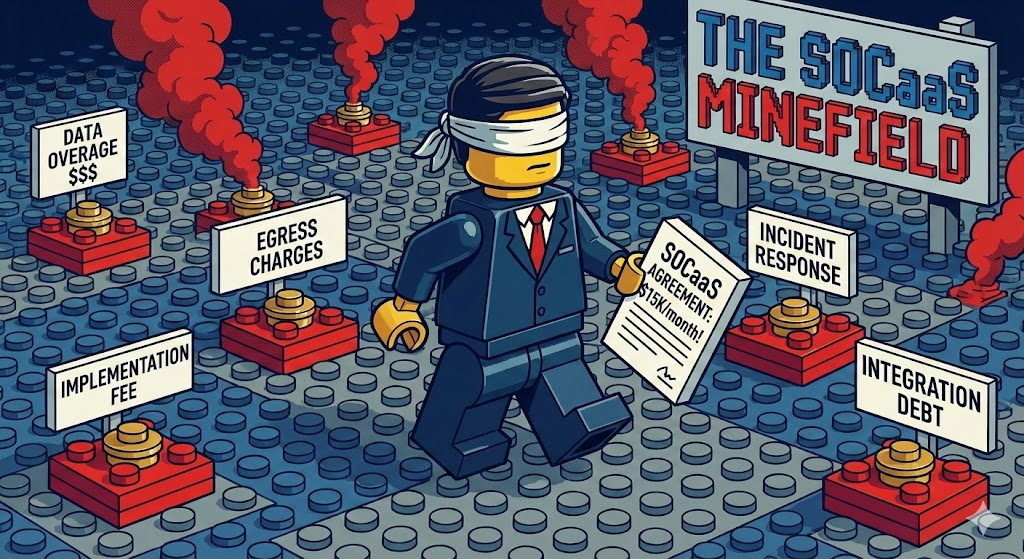
By Managing cybersecurity budgets in 2026 is like navigating a minefield blindfolded. Organizations are increasingly turning to Security Operations Center as a Service (SOCaaS) as a cost-effective alternative to building internal teams, attracted by promises of 24/7 monitoring, expert analysts, and predictable monthly fees. Yet this comfort is dangerously misleading.
The truth is that many SOCaaS contracts hide substantial costs beneath their attractive base pricing. What looks like a $15,000 monthly subscription can balloon to $40,000 or more once hidden fees, usage overages, and integration expenses pile up. The result? Budget shock, finger-pointing, and security teams stuck explaining why their “cost-saving” solution just blew through the annual forecast.
This article draws on industry analysis, procurement frameworks, and real-world case studies to expose the five most common hidden costs in SOCaaS engagements – and more importantly, how to avoid them before they crater your security budget.
The SOCaaS Economics Illusion: Why “Predictable Pricing” Isn’t Always Predictable
Before diving into specific hidden costs, it’s essential to understand the fundamental pricing tension in the SOCaaS market. Providers face a challenging balancing act: they need to offer competitive base pricing to win deals, but they also need to protect their margins against unpredictable client behaviors like data spikes, integration complexity, or high-touch incident response.
The solution? Many providers shift costs from the visible “base fee” to less obvious line items – usage overages, implementation charges, data egress fees, and premium service tiers. This isn’t necessarily malicious, but it creates a dangerous knowledge gap between what buyers think they’re paying and what they’ll actually be invoiced.
The Real Cost Structure of SOCaaS
Understanding where costs hide requires looking beyond the marketing materials to the actual contract architecture:
- Visible Base Fee: The advertised monthly or annual subscription, typically $10,000–$50,000 for mid-market organizations
- Semi-Visible Add-Ons: Features like advanced threat hunting, compliance reporting, or dedicated analysts that appear as “optional upgrades”
- Hidden Variables: Data ingestion overages, onboarding fees, integration costs, and incident response surcharges that only emerge during implementation or your first major security event
The gap between the first number and the total cost of ownership can be 40–70%, turning what seemed like a budget-friendly decision into a financial liability.
Hidden Cost #1: Data Ingestion Overages – The Silent Budget Killer
The most common and most expensive hidden cost in SOCaaS is data ingestion overages. Most providers use volume-based pricing models, charging between $200 and $500 per gigabyte (GB) of data processed monthly. Sounds reasonable – until you realize how quickly data volumes can spiral.
Why Data Volumes Explode
Modern enterprises generate staggering amounts of telemetry:
- A single firewall can generate 50–100 GB of logs monthly
- Cloud environments (AWS, Azure, GCP) produce 200–500 GB per 1,000 resources
- Endpoint Detection and Response (EDR) tools generate 10–20 GB per 1,000 endpoints
- DNS query logs alone can exceed 1 TB monthly in large organizations
The Math That Kills Budgets:
Let’s say you signed a contract with a 500 GB monthly allowance at $300/GB overage rates. Your actual usage:
- Firewalls: 80 GB
- Cloud logs: 350 GB
- EDR: 150 GB
- DNS: 200 GB
- Total: 780 GB
Overage: 280 GB × $300 = $84,000 in additional charges – enough to double or triple your expected annual cost.
The “Noise Tax” Problem
Here’s what makes this worse: fewer than 40% of ingested logs provide real investigative value. The remainder is noise – administrative heartbeats, known-benign service accounts, verbose debug traces, and duplicate information. Organizations are literally paying premium prices to store and analyze digital garbage.
How to Avoid Data Ingestion Overages
1. Implement Source-Side Filtering
Deploy a centralized logging layer between your data sources and the SOCaaS platform. This layer filters out:
- Administrative pulse/heartbeat logs
- Known benign automation (backup scripts, vulnerability scanners)
- Redundant or duplicate events
- Non-security-relevant debug traces
Organizations implementing intelligent filtering reduce ingestion volumes by 45–70%, cutting costs by hundreds of thousands annually.
2. Adopt Tiered Storage Architecture
Not all data needs expensive real-time analysis. Use a two-tier approach:
- Hot Tier (Analytics): High-fidelity security events requiring immediate detection – EDR alerts, failed authentication attempts, privilege escalations
- Cold Tier (Data Lake): High-volume logs used for forensics or compliance – DNS queries, NetFlow data, audit logs
Modern SIEM platforms like Microsoft Sentinel show that cold storage costs as little as $0.05/GB compared to $2.30–$2.90/GB for analytics-tier data – a 98% cost reduction for lower-priority telemetry.
3. Negotiate Volume Commitments Carefully
Don’t sign contracts with rigid volume caps and steep overage penalties. Instead:
- Request consumption-based pricing that scales linearly
- Negotiate “soft caps” with warning alerts at 75% and 90% usage
- Include quarterly reviews to adjust baselines as your environment grows
- Demand transparent usage dashboards with daily granularity
Get SOCaaS Cost Optimization Guide
Hidden Cost #2: Implementation and Onboarding Fees – The $50,000 Surprise
Here’s a conversation that happens far too often:
Security Leader: “We signed the SOCaaS contract! $25,000/month, total cost of ownership will be $300,000 annually.”
Finance Leader: “Great! When do we start saving money?”
Security Leader: “Well… there’s a $35,000 implementation fee I just found out about.”
Finance Leader: “…”
Implementation fees are the second most common hidden cost, ranging from $5,000 for simple deployments to $50,000+ for complex, multi-cloud environments. These charges cover:
- Initial log source integration and API connections
- Custom detection rule development and tuning
- Platform configuration and user training
- False positive reduction and baseline establishment
Why Implementation Costs Spiral
The challenge is that every organization’s security stack is unique. Your specific combination of cloud platforms, SaaS applications, identity providers, and legacy systems creates integration complexity that can’t be templated away.
Common Implementation Cost Drivers:
- Legacy system integration: Older firewalls, IDS/IPS systems, or proprietary tools often lack modern APIs, requiring custom connectors
- Multi-cloud environments: Each cloud platform (AWS, Azure, GCP) has different logging architectures and APIs
- Custom applications: Internal tools require bespoke log parsing and normalization
- Regulatory requirements: Compliance needs (HIPAA, PCI-DSS, GDPR) demand specific reporting configurations
How to Avoid Implementation Fee Shock
1. Demand Itemized Implementation Quotes
Never accept a vague “implementation services” line item. Require:
- Breakdown by data source type and volume
- Estimated hours for custom rule development
- Clear deliverables and acceptance criteria
- Fixed-price vs. time-and-materials distinction
2. Leverage Pre-Built Integrations
Modern SOCaaS providers maintain libraries of 100+ pre-built integrations. Prioritize providers with robust connector ecosystems for:
- Your specific EDR platform (CrowdStrike, SentinelOne, Microsoft Defender)
- Your cloud providers (AWS CloudTrail, Azure Monitor, GCP Cloud Logging)
- Your identity systems (Okta, Azure AD, Ping Identity)
- Your SaaS applications (Microsoft 365, Salesforce, Workday)
Pre-built integrations can reduce implementation time from 8–12 weeks to 2–4 weeks, cutting costs by 50–70%.
3. Negotiate Implementation Fee Caps
Include contract language that caps implementation fees at a percentage of the first year’s subscription (typically 10–15%). If the provider discovers unexpected complexity, they absorb the cost rather than hitting you with change orders.
4. Phase Your Deployment
Instead of integrating 50 data sources simultaneously, use a phased approach:
- Phase 1 (Week 1-2): Critical security telemetry – EDR, authentication, privileged access
- Phase 2 (Week 3-4): Cloud infrastructure and network logs
- Phase 3 (Week 5-8): SaaS applications and compliance logs
This spreads implementation costs over time and allows you to validate value before committing to full-scale integration.
Stop Overpaying for Noise: Your SOCaaS Cost Optimization Framework
Hidden Cost #3: Data Egress Fees – The Cloud Provider’s Secret Tax
Data egress fees are the hidden tax of cloud computing, and they hit SOCaaS deployments particularly hard. While cloud providers make it free to move data into their platforms, pulling data out – whether to your SOCaaS provider’s analytics engine or during a forensic investigation – triggers steep charges.
The Economics of Egress
Hyperscalers typically charge:
- Intra-region transfers: Free to $0.01/GB
- Inter-region transfers: $0.02–$0.10/GB
- Internet-based egress: $0.05–$0.20/GB
These fees might seem trivial until you calculate the math at scale. An organization processing 50 TB of log data monthly and sending it to an external SOCaaS platform via internet egress:
50,000 GB × $0.09/GB = $4,500/month = $54,000 annually
And that’s just for routine monitoring. During a major incident requiring deep forensic analysis, rehydrating archived logs from cold storage can trigger massive egress spikes that devastate quarterly budgets.
The “Hotel California” Effect
The most insidious aspect of egress fees is vendor lock-in. Once your logs are stored in a provider’s cloud, moving them to a different SOCaaS vendor or bringing operations back in-house becomes prohibitively expensive. Organizations have reported egress bills exceeding $100,000 when switching providers – effectively making them prisoners of their current vendor.
How to Avoid Data Egress Disasters
1. Architect for Locality
Place your SOCaaS processing infrastructure in the same cloud region as your primary data sources. This keeps transfers within the provider’s internal network, avoiding internet egress fees entirely.
Example:
- If your AWS workloads are in us-east-1, ensure your SOCaaS provider’s analytics platform is also in us-east-1
- For multi-cloud environments, use regional processing hubs rather than a single centralized architecture
2. Leverage Private Connectivity
Use dedicated network links like AWS Direct Connect, Azure ExpressRoute, or GCP Cloud Interconnect. While these services have upfront costs ($300–$500/month for a 1 Gbps connection), they reduce egress fees by 30–40% compared to internet-based transfers.
3. Negotiate Egress Waivers
During contract negotiations, specifically address egress:
- Demand that the provider cover egress costs for routine operations
- Cap egress fees at a percentage of monthly subscription (typically 5–10%)
- Include provisions for waived egress during vendor transitions or service terminations
4. Use VPC Endpoints and PrivateLink
Keep traffic within the cloud provider’s internal network using:
- AWS PrivateLink
- Azure Private Endpoint
- GCP Private Service Connect
These services eliminate public internet routing, significantly reducing or eliminating egress charges while improving security and latency.
Hidden Cost #4: Incident Response Surcharges – When Your Emergency Becomes an Invoice
Most SOCaaS contracts include basic monitoring and Tier 1 alert triage. What they don’t clearly communicate is that deep incident response – the kind you need during an actual breach – often costs extra.
The Tiered Service Trap
Providers structure incident response in tiers:
- Tier 1 (Included): Alert triage, basic investigation, playbook execution
- Tier 2 (Sometimes Included): Threat hunting, log correlation, IOC analysis
- Tier 3 (Usually Extra): Forensic investigation, breach containment, remediation support
During a real security incident, you need Tier 3. And that’s when you discover the surcharges:
- Per-incident fees: $5,000–$25,000 per investigation
- Hourly consulting rates: $200–$500/hour for senior analysts
- Emergency response premiums: 1.5–2× normal rates for after-hours or weekend incidents
Real-World Example:
A mid-sized financial services firm experienced a ransomware incident on a Friday evening. Their SOCaaS provider’s response:
- Weekend emergency rate: $400/hour
- Forensic analyst hours: 60 hours
- Incident response consulting: $15,000 flat fee
- Total surprise bill: $39,000
The organization had budgeted $300,000 annually for SOCaaS. This single incident consumed 13% of their annual security budget in one weekend.
How to Avoid Incident Response Surprises
1. Define “Incident Response” in the Contract
Ensure your Service Level Agreement (SLA) clearly specifies:
- What constitutes an “incident” vs. routine monitoring
- How many incidents are included in base pricing
- Hourly rates for additional investigation time
- Whether emergency response carries surcharges
2. Negotiate Incident Retainers
Include a pre-paid incident response retainer in your contract:
- 3–5 major incidents annually included in base pricing
- Defined response times (sub-15 minutes for critical threats)
- No surcharges for after-hours or weekend response
- Excess incidents billed at a pre-agreed, capped rate
3. Understand Response Scope
Clarify what the provider will and won’t do during an incident:
- Included: Threat identification, IOC analysis, containment recommendations
- Extra: Hands-on remediation, system reimaging, credential resets, stakeholder communication
Many organizations assume “incident response” means the provider will actively remediate the threat. In reality, most SOCaaS providers offer guidance and recommendations – the actual execution remains your responsibility unless you pay for additional services.
Hidden Cost #5: Integration and Customization Debt – The Tax That Never Stops
The final hidden cost is the most insidious because it’s ongoing: integration debt. Every custom rule, unique data parser, or bespoke playbook you require creates maintenance overhead that compounds over time.
Why Integration Debt Accumulates
Your security environment is dynamic:
- New applications are deployed
- Cloud architectures evolve
- Regulatory requirements change
- Threat models shift
Each change requires updates to your SOCaaS integration:
- Custom detection rules need tuning
- Log parsers require updates for new data formats
- Playbooks need expansion for new asset types
- Compliance reports need reconfiguration
Providers handle these changes through:
- Change request fees: $1,000–$5,000 per modification
- Monthly maintenance surcharges: 10–20% of implementation costs
- Hourly professional services: $200–$350/hour for custom work
The Debt Accumulation Pattern:
- Month 1: Base implementation complete
- Month 3: New SaaS app requires custom parser (+$2,500)
- Month 6: Regulatory change requires new detection rules (+$4,000)
- Month 9: Cloud migration requires log source reconfiguration (+$8,000)
- Month 12: Total customization debt: $14,500 in year one alone
This debt grows exponentially in Years 2 and 3 as your environment becomes more complex and diverges further from the provider’s “standard” configuration.
How to Minimize Integration Debt
1. Prioritize Standards-Based Architecture
Build your security stack using widely adopted, well-supported technologies:
- Standard SIEM formats (CEF, JSON, Syslog)
- Common identity protocols (SAML, OAuth, OpenID Connect)
- Well-documented APIs with broad connector support
Proprietary or niche tools create ongoing integration debt as they require custom maintenance.
2. Negotiate Included Customization Hours
Include a monthly or quarterly allocation of customization hours in your base contract:
- 10–20 hours per quarter for rule tuning and updates
- No additional fees for changes within this allocation
- Unused hours don’t roll over (encouraging proactive optimization)
3. Demand Self-Service Capabilities
Modern SOCaaS platforms should offer:
- Low-code/no-code detection rule builders
- Template libraries for common use cases
- Direct API access for custom integrations
- Detailed documentation and community support
Self-service capabilities let your team make minor adjustments without incurring professional services fees.
4. Plan for “Standard” Growth
When evaluating providers, ask:
- How often do you update standard integrations?
- Do you support the latest API versions for major platforms?
- What’s your roadmap for new data source support?
- How do you handle breaking changes from third-party vendors?
Providers with robust, proactive integration maintenance programs reduce your long-term debt burden.
The Contractual Shield: Protecting Yourself Before You Sign
Understanding hidden costs is one thing. Protecting yourself contractually is another. Before signing any SOCaaS agreement, conduct a “Five-Minute Contract Scan” for these red flags:
Critical Contract Clauses to Negotiate
1. Usage Caps and Overage Terms
- Soft caps with alerts at 75% and 90% of limits
- Linear overage pricing (not tiered penalties)
- Quarterly baseline adjustments for growing environments
- Grace periods during unexpected spikes (e.g., incident response, DDoS attacks)
2. Implementation Fee Transparency
- Fixed-price implementation for standard integrations
- Itemized quotes for custom work
- Cap implementation fees at 10–15% of Year 1 subscription
- Clear deliverables and acceptance criteria
3. Data Portability Rights
- Your data must be exportable in standard formats (JSON, CSV, CEF)
- No fees for data retrieval or export
- 90-day transition period with full access if you terminate
- No “hostage” clauses tying data access to payment status
4. Service Level Agreements (SLAs)
- Mean Time to Detect (MTTD): Sub-15 minutes for critical threats
- Mean Time to Respond (MTTR): Sub-60 minutes for containment
- Incident response scope clearly defined
- Financial credits for SLA violations (typically 10–25% of monthly fee)
5. The “Indemnification Trap”
Search your contract for the word “indemnify.” Standard contracts often make you liable for the provider’s security failures. Negotiate mutual indemnification with:
- Provider indemnifies you for their negligence or breaches
- Liability caps at 12–24 months of fees (not unlimited)
- Specific exclusions only for your willful misconduct
The Path Forward: Building a Sustainable SOCaaS Partnership
SOCaaS cost optimization isn’t about spending less – it’s about spending smarter. The goal is to achieve superior security outcomes while maintaining financial predictability and avoiding budget shocks.
A Strategic Maturation Framework
Phase 1: Assessment (Months 1-2)
- Audit current log sources and data volumes
- Identify high-volume/low-value telemetry for filtering
- Benchmark current security metrics (MTTD, MTTR, cost per investigation)
- Document existing integration points and custom requirements
Phase 2: Procurement (Months 2-3)
- Evaluate 3–5 providers using a structured scorecard
- Prioritize providers with robust pre-built integrations for your stack
- Negotiate contracts using the clauses outlined above
- Include a 30–90 day pilot to validate costs and capabilities
Phase 3: Optimization (Months 3-6)
- Implement tiered storage architecture (hot/cold data separation)
- Deploy source-side filtering to reduce ingestion volumes by 45–70%
- Establish self-service capabilities for minor rule adjustments
- Create quarterly cost review processes
Phase 4: Maturation (Months 6-12)
- Transition from reactive monitoring to proactive threat hunting
- Automate Tier 1 alert triage to reduce analyst burden
- Expand coverage to include compliance and vulnerability management
- Document lessons learned and refine cost models
Measuring Success: The Right Metrics
Don’t measure SOCaaS success solely by cost. Track these operational and financial metrics:
Operational Metrics:
- Mean Time to Detect (MTTD): Industry benchmark is <15 minutes
- Mean Time to Respond (MTTR): Industry benchmark is <60 minutes
- Alert false-positive rate: Target <20%
- Analyst hours saved through automation: Target >60% of Tier 1 workload
Financial Metrics:
- Cost per accurate investigation: Compare to internal SOC benchmarks
- Total Cost of Ownership (TCO): Include all hidden fees, not just base subscription
- Incident response costs: Track separately from routine monitoring
- Budget variance: Target <10% deviation from projected annual costs
From Hidden Costs to Hidden Value
The SOCaaS market will reach $28.5 billion by 2029 – a testament to its strategic value. But that value only materializes when organizations understand the full cost structure and negotiate accordingly.
Hidden costs aren’t inherently evil. They’re business realities driven by the complexity of modern security operations. The key is transforming them from surprises into planned, managed expenses through:
- Transparent contract negotiation
- Intelligent architecture design
- Proactive cost management
- Continuous optimization
Organizations that master these disciplines don’t just save money – they build security programs that scale efficiently, respond faster, and protect more comprehensively than traditional models ever could.
The question isn’t whether SOCaaS is worth it. The question is whether you’re buying it smartly.
Need help now?
UnderDefense’s Security Team is available 24/7. Immediate triage, containment, and forensic assistance.
1. What are the most common hidden costs in SOCaaS contracts?
The five most common hidden costs are: (1) data ingestion overages when you exceed volume limits, (2) implementation and onboarding fees for integrating your security stack, (3) cloud data egress fees for moving logs between platforms, (4) incident response surcharges for deep forensic investigations, and (5) ongoing integration and customization debt as your environment evolves. These can add 40–70% to your expected annual costs.
2. How much should I budget for SOCaaS implementation?
Implementation fees typically range from $5,000 for simple deployments to $50,000+ for complex multi-cloud environments. As a rule of thumb, budget 10–15% of your first year’s subscription for implementation. For a $300,000 annual contract, expect $30,000–$45,000 in onboarding costs. Negotiate fixed-price implementation for standard integrations and itemized quotes for custom work.
3. What's the difference between MSSP and SOCaaS pricing?
Traditional MSSPs typically use per-asset or per-device pricing and require longer contract terms (2–3 years). SOCaaS providers often use consumption-based models (per GB, per user, or tiered packages) with more flexible terms. SOCaaS generally offers 30–50% lower total costs than MSSPs because providers leverage economies of scale, multi-tenant platforms, and AI automation. However, SOCaaS may have higher variable costs if data volumes spike.
4. How can I reduce data ingestion costs without compromising security?
Implement source-side filtering to eliminate noise like administrative heartbeats and known-benign activity – this can reduce ingestion by 45–70%. Use tiered storage, sending high-fidelity security events to expensive analytics tiers and compliance logs to low-cost data lakes. Organizations using Microsoft Sentinel save up to 98% on storage costs by routing non-critical logs to Data Lake tiers at $0.05/GB vs. $2.30–$2.90/GB for analytics.
5. What should I look for in SOCaaS contract SLAs?
Demand measurable SLAs with financial penalties: Mean Time to Detect (MTTD) under 15 minutes for critical threats, Mean Time to Respond (MTTR) under 60 minutes for containment, and 24/7 analyst coverage with defined escalation paths. Include financial credits (10–25% of monthly fees) for violations. Ensure the contract clearly defines what triggers an “incident” vs. routine monitoring and whether incident response carries additional fees.
6. Are cloud data egress fees really that significant?
Yes – egress fees can add $50,000–$100,000+ annually for large deployments. Cloud providers charge $0.05–$0.20/GB for internet-based data transfers. An organization processing 50 TB monthly would pay $54,000 annually in egress alone. During vendor transitions, egress bills can exceed $100,000, creating effective lock-in. Mitigate this by co-locating SOCaaS processing in your cloud regions and using private connectivity like AWS Direct Connect.
7. How do I avoid vendor lock-in with SOCaaS?
Negotiate strong data portability clauses: your data must be exportable in standard formats (JSON, CSV) with no retrieval fees. Include 90-day transition periods with full access if you terminate. Avoid proprietary logging formats and use standards-based architecture (CEF, Syslog). Choose providers with open APIs and documented export procedures. Most importantly, never sign contracts that tie data access to payment status – this creates a “hostage” situation during disputes.
8. What's the real ROI of SOCaaS vs. in-house SOC?
Mid-sized organizations typically save $1.5–$2.2 million annually by choosing SOCaaS over in-house operations. In-house SOCs cost $1–$4 million annually (salaries, SIEM licensing, infrastructure, training), while SOCaaS ranges from $120,000–$400,000 for comparable coverage. ROI is achieved in 6–12 months. Beyond direct savings, SOCaaS provides faster time-to-value (2–6 weeks vs. 6–18 months), access to specialized expertise, and 24/7 coverage without hiring challenges.
9. How often do SOCaaS contracts have hidden incident response fees?
Approximately 60–70% of SOCaaS contracts charge extra for deep incident response beyond basic alert triage. Per-incident fees range from $5,000–$25,000, with senior analyst rates of $200–$500/hour. Weekend/after-hours incidents often carry 1.5–2× premiums. Protect yourself by negotiating incident retainers (3–5 major incidents annually included), defining “incident response” scope clearly, and capping hourly rates with no after-hours surcharges.
10. What's integration debt and how do I minimize it?
Integration debt is the ongoing cost of maintaining custom rules, parsers, and playbooks as your environment evolves. Changes to applications, cloud architectures, or compliance requirements trigger modification fees ($1,000–$5,000 each) or hourly professional services ($200–$350/hour). Minimize debt by using standards-based architecture, negotiating included customization hours (10–20 quarterly), demanding self-service rule builders, and choosing providers with proactive integration maintenance programs.
The post 5 Hidden Costs of SOCaaS and How to Avoid Them appeared first on UnderDefense.